
- Comedy podcasts now generate approximately 17% of all podcast advertising revenue, highlighting their growing influence as a central powerhouse for high-level brand engagement.
- Improvised podcast advertisements provide a more authentic listener experience that results in up to three times higher brand recall and 1.5 times higher conversion rates than traditional digital audio ads.
- Dynamic ad insertion now powers more than 90% of podcast ad revenue, making an evergreen improvised outline strategy essential for maintaining relevance across long-term downloads.
- Transitioning to bullet-point audio scripts allows brands to secure essential brand anchors and legal non-negotiables while giving comedians the creative freedom to foster deep emotional connections.
The podcasting industry is changing rapidly, with comedy podcasts emerging as a central powerhouse for high-level brand engagement. Comedy podcasts now generate approximately 17% of all podcast advertising revenue by niche, underscoring their influence on modern consumer behavior. Brands that once relied on traditional broadcast methods are finding that the podcast medium requires a more nuanced approach to reach listeners effectively.
Successful brands are shifting their budgets toward improvised podcast ads because they mimic the program's natural flow rather than interrupting it. Moving toward outlines allows creators to maintain their creative freedom while meeting the marketing requirements of a sophisticated advertising campaign. Understanding this shift is the first step toward mastering the art of host-read advertising in a comedic context.
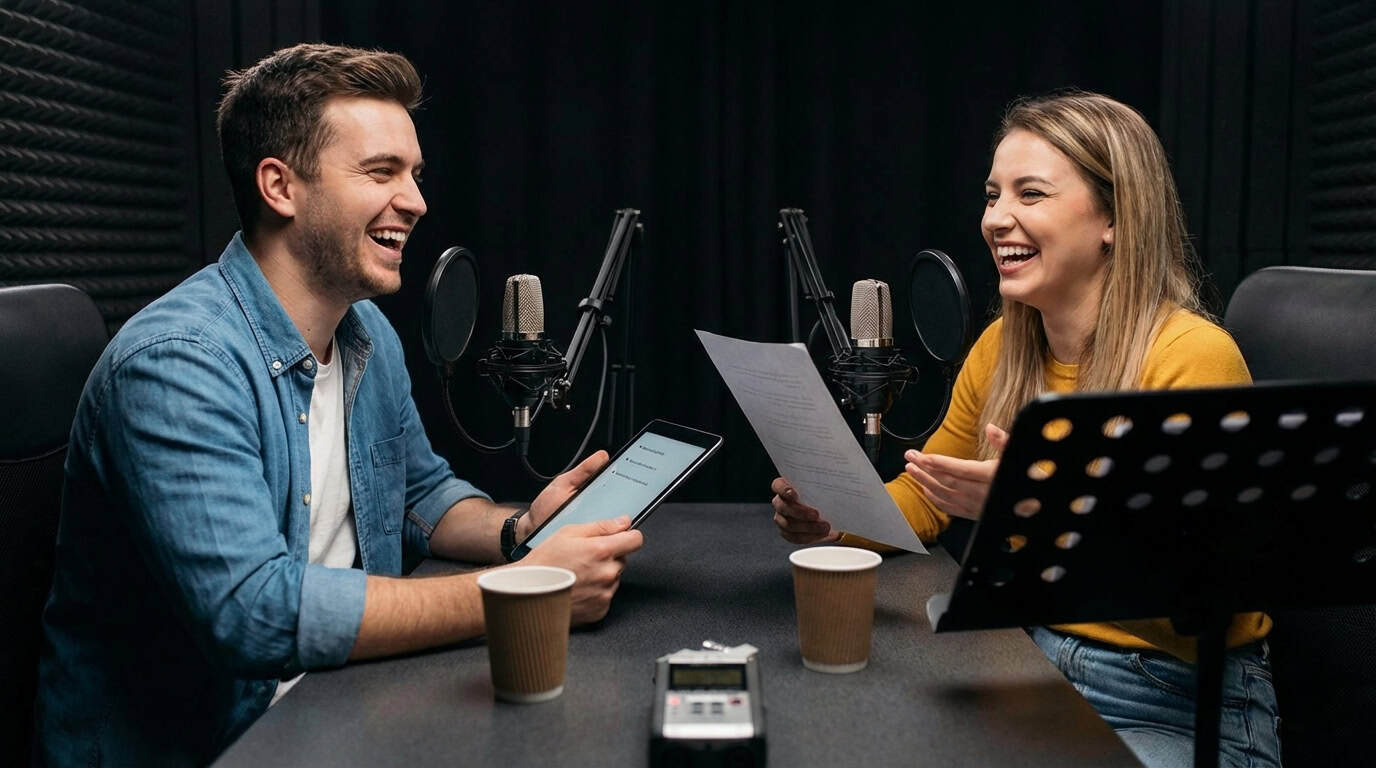
The Evolution of Podcast Advertising: Why Rigid Scripts Are Failing Comedy
Radio-style ad reads were designed for a medium where the audience expected a clear separation between entertainment and commercial content. The intimate nature of podcasting makes rigid scripts feel forced and out of place. Comedians spend years developing a specific voice and rhythm that their audience grows to love and expect during every episode. It's jarring for a listener when a host suddenly shifts into a robotic corporate tone.
The downside to scripts is that the talent must read them. It takes professional coaching or years of consistent practice to make a written script sound truly natural in a long-form audio setting. Scripted podcast content typically doesn't work in long form because it lacks the spontaneity that defines the medium. Leading comedy podcasts drive brand engagement by fostering deep emotional connections with their niche communities rather than reading text.
The uncanny valley effect occurs when a comedian who has been irreverent for 40 minutes suddenly adopts a dry tone. This abrupt shift signals to the listener that the host is no longer in control of the content. They're simply acting as a corporate mouthpiece. When listeners perceive a script as overly mechanical, they're far more likely to skip the segment entirely. Maintaining the parasocial relationship between the host and the listener is fundamental to ensuring that the brand message is actually remembered.
Technical Implementation: Baked-In vs. Dynamic Ad Insertion (DAI)
Understanding the delivery method is a necessary step before determining your podcast ad integration strategies for a campaign. Baked-in ads are part of the permanent audio file and remain in the episode for the entire life of the content. The baked-in format allows for specific inside jokes directly related to the episode's events. It creates a sense of time and place that can make the advertisement feel like a historic part of the show's lore.
Dynamic ad insertion allows brands to insert ads into a podcast at the time of download. Dynamic insertion makes the content relevant to the current date, even if the episode is years old. Dynamic ad insertion now powers more than 90% of podcast ad revenue, according to recent industry research from the IAB and PwC. DAI ads require a more evergreen improv approach because they might be heard months or years after the episode was originally recorded.
Choosing between these formats depends on your specific campaign goals and the desired longevity of the message. Baked-in ads offer deeper integration, while dynamic insertion provides better targeting and scale for national campaigns. Both methods benefit from the improvised outline strategy if the creative approach is tailored to the technical requirements. You can learn more about dynamic ad insertion vs. baked-in ads to determine which one best fits your budget.
The Psychology of the Riff: Why Listeners Engage with Improvised Content
Audiences respond more positively to improvised advertisements because they prioritize authenticity and vulnerability in their digital interactions. When a host riffs on a product, listeners feel like they're hearing a genuine endorsement rather than a paid recitation. High engagement levels build a unique sense of trust that traditional advertising cannot replicate in a comedic environment. It turns the ad break into a part of the show's entertainment value.
Recent studies show that podcast ads generate up to 3 times higher brand recall and 1.5 times higher conversion rates than traditional digital audio ads. Listeners stay tuned because they're entertained by the host's comedic take on the brand. They don't want to miss a potential joke that might happen during the riffing. Successful comedy podcast sponsorships rely on this tension between corporate messaging and comedic subversion to keep the audience focused.
Three in four listeners prefer advertisements voiced directly by the podcast's host. Our research indicates that 42% of podcast listeners feel a deep sense of connection that traditional media personalities often lack. Creating content that feels native to the program ensures that the advertising becomes a part of the listener's routine. When the host is having fun, the audience is far more likely to develop a positive association with the brand.
The Host-Brand Affinity Loop
The success of an improvised ad relies on the existing relationship between the listener and the host. When a comedian riffs on a brand, they are essentially lending their hard-earned credibility to the product. This creates an affinity loop in which the brand becomes associated with the positive emotions evoked by the show's humor. Marketers should view this as a long-term asset rather than a one-off transaction.
Strategic Frameworks for Creating Effective Bullet-Point Outlines
Brands can move away from full scripts without losing control of their narrative by adopting bullet-point audio scripts. Using an outline provides boundaries for the host while allowing them to find their own path to a punchline or a personal anecdote. An outline serves as a roadmap, guiding the host toward key brand milestones without dictating every word they must say. It's the hybrid model that professional comedy podcast media buying strategies currently favor. A bullet-point audio script is a brief document that lists the essential talking points and brand anchors for a podcast host. It provides the structure of the ad read, but allows the host to use their own words in delivery. This format is the preferred method for comedy podcasts because it preserves the host's authentic voice.
Developing the Creative Brief for Comedians
Creating a brief for a comedian is different than writing for a standard influencer. You must provide enough information to be accurate, but enough space to be funny. The brief should focus on the brand's feelings rather than on a list of rigid demands. Comedians thrive when they understand the why behind a product rather than just the what.
Professional podcast sponsorship management involves teaching the host about the brand's personality. If your brand is playful, tell them that they have permission to make fun of the product's packaging. If your brand is serious, explain the importance of the technical specs, but let them find a funny way to describe them. Clear communication between the brand and the talent prevents misunderstandings during the recording process.
Comparing Rigid Scripts and Improvised Outlines
A rigid script often includes every single word from "Hello" to the final "Goodbye." It's written in the third person and uses marketing-speak that feels unnatural when spoken aloud. In contrast, an improvised outline provides a simple greeting and then lists three key talking points. The host is encouraged to share a story about how they actually used the product in their own life.
The rigid script might require the host to mention the product name five times within sixty seconds. This usually sounds forced and causes listeners to tune out. The outline suggests mentioning the product name at the beginning and the end. This gives the host forty seconds in the middle to riff on a funny hypothetical scenario involving the brand. The outline method ensures the brand stays top of mind without becoming a nuisance.
Defining the Non-Negotiables and Brand Anchors
It's important to identify the core elements of the advertisement that must remain unchanged for legal or branding reasons. These non-negotiables typically include the exact product name, the specific offer code, and the unique selling proposition. Providing these anchors to a comedian should feel like giving them a springboard for a bit. They need these fixed points to navigate the improvisation.
A host might take a specific product feature and turn it into a humorous scenario that involves their co-host. Structured improvisation allows the host to hit the required brand anchor while staying within the established tone of their show. When anchors are presented as challenges, comedians are often more motivated to integrate them creatively into their host riffing commercials. The goal is to ensure that the listener remembers the brand even if the conversation is absurd.
Comedic Audio Copywriting: Writing for the Ear, Not the Eye
Writing for a comedian requires a different set of skills than writing traditional marketing copy for a website. Comedic audio copywriting focuses on providing prompts that trigger a comedian's imagination. You should use sensory details and relatable scenarios that are easy to expand upon during a live recording. The language in an outline should be simple and avoid corporate jargon that is difficult to riff on naturally.
Using humor in the outline itself can help build rapport with the host before they even hit the record button. When a comedian sees that a brand has a sense of humor, they're more likely to put extra effort into the ad read. A collaborative spirit results in a more engaging commercial that resonates with the target audience. It's about creating a conversation between the brand manager and the creator that eventually reaches the listener.
Optimizing podcast ad ROAS often comes down to the quality of these prompts. If the prompt is too vague, the host might ramble without a point. If it's too specific, the host will feel restricted and lose their comedic edge. Finding the sweet spot involves presenting a clear problem and a clear solution, while letting the host find the funny path between them. The true power of the improvised outline resides in this balance of structure and freedom.
Navigating Mandatory Legal and Promotional Requirements
Regulated industries like fintech, healthcare, and sports betting often face the challenge of including mandatory disclaimers. These legal requirements can feel like momentum killers in a comedic episode if they aren't handled with care. Brands must find a way to satisfy compliance departments without destroying the lighthearted nature of the podcast environment. It's often helpful to keep these sections separate from the improvised riff.
One effective technique is the use of time-stamped markers or post-roll placement for long legal disclaimers. Separating these elements keeps the mid-roll improvised content clean and funny while still meeting all regulatory standards. Alternatively, a host can acknowledge the legal text with a self-aware tone that signals a brief departure from the bit. The self-aware tone creates a clear distinction between the entertainment and the legal necessities while maintaining the host's authentic voice.
Pharma and gaming ads must be particularly careful about the wording of their health warnings. Providing a pre-recorded disclaimer that plays immediately after the host-read portion is a common strategy. Automation ensures that the host isn't forced to read technical legal jargon that ruins their comedic timing. When legal hurdles are integrated into the show's format, they become less of an obstacle to the overall listener experience.
Managing Brand Safety in an Unpredictable Improv Environment
Brand managers often worry that giving a comedian too much freedom could lead to potential safety issues. A robust pre-campaign vetting process is the best way to mitigate these risks. Establishing a list of no-go zones provides clear boundaries for the host to respect while they're improvising. You should understand the difference between brand and performance elements in direct-response ads to manage these risks better.
Utilizing AI-Driven Brand Safety Tools
Modern campaigns often supplement manual vetting with AI-driven transcript analysis. Tools like Barometer or Magellan AI allow brand managers to monitor the context of improvised riffs at scale. These platforms provide sentiment analysis and keyword tracking to ensure that the host's comedy remains within the agreed-upon safety parameters. Integrating these technologies provides an extra layer of security for risk-averse brands.
Post-production reviews serve as a safety net for brands that are new to the world of improvised podcast ads. These steps help the brand ensure the core message is delivered accurately and the humor remains appropriate. Trust is ultimately built through clear communication of expectations rather than micromanaging every word. Most professional podcasters understand the value of their sponsorships and will work hard to protect their sponsors' brand reputations.
Metrics of Authenticity: Measuring the Success of Non-Linear Ads
Measuring the return on investment for improvised ads requires looking beyond simple click-through rates. While conversion rates remain primary metrics, brands should also analyze predicting ad fatigue and social media sentiment. If listeners are talking about the ad on social platforms, it's a strong indicator that the improvised content was successful. It shows that the audience was paying attention instead of just letting the audio play.
According to Nielsen's 2025 Podcast Ad Effectiveness Report, host-read ads deliver a 68% higher brand recall rate than pre-recorded spots. Furthermore, host-read podcast ads result in a +10-point increase in unaided recall compared to pre-produced and announcer-read spots. This suggests that the emotional connection created through improvisation has a lasting impact on how listeners perceive a brand. Long-term brand lift is often significantly higher when a host is allowed to be themselves.
Analyzing Bumper's data confirms that 90% of audiences listen through ad breaks when the content is engaging. High retention rates during the commercial segment prove that the advertising provides value to listeners. Success in this space is defined by the brand's ability to become a welcome guest in the listener's ears. When listeners don't skip, your cost per impression decreases while your impact increases.
The Role of the Media Agency in the Creative Bridge
An advertising agency acts as a necessary intermediary between a brand's rigid requirements and a comedian's creative needs. Agencies serve as translators, turning corporate goals into bullet-point audio scripts that hosts can use easily. A media agency bridge ensures that both parties are satisfied with the final product. Our team at Mynt Agency optimizes podcast media campaigns through data-driven research and creative oversight.
Agency experience helps identify which hosts excel at improvisation and which require more structure. Not every podcaster is a natural comedian, and a media agency can help a brand select the right talent. Host vetting saves time and prevents potential brand safety issues before the campaign even launches. It allows the brand to focus on the big picture while the agency handles the logistical details.
A dedicated agency also manages the logistical side of tracking and optimization to ensure the campaign delivers precise results. By combining creative oversight with data-driven media buying, an agency helps a brand effectively scale its podcast presence. Specialized knowledge is required for brands that want to navigate the complex world of international podcasting. Professional management ensures that your improvised strategy leads to measurable growth.
Frequently Asked Questions About Improvised Podcast Advertising
What is a bullet-point audio script? A bullet-point audio script is a brief document that lists the essential talking points and brand anchors for a podcast host. It provides the structure of the ad read, but allows the host to use their own words in delivery. The outline format is the preferred method for comedy podcasts because it preserves the host's authentic voice.
How do improvised podcast ads compare to scripted commercials? Improvised podcast ads typically sound more natural and conversational than scripted commercials. Scripted ads often feel like an interruption to the content, whereas improvised ads feel like a part of the show. Data suggests that improvised, host-read ads result in higher brand recall and lower skip rates than scripted alternatives.
Do improvised ads risk brand safety? While there is more unpredictability in an improvised format, the risks can be managed through a thorough vetting process and clear creative briefs. Establishing no-go zones and using post-production reviews provides a safety net for advertisers. Most professional comedians understand how to stay funny without crossing a brand's specific ethical or legal boundaries.
Elevate Your Brand Voice With Podcast Advertising
Transitioning from rigid scripts to improvised outlines is a necessary evolution for brands that want to remain relevant in the digital audio space. Authenticity is the primary currency of podcasting, and relinquishing some control often leads to much higher engagement and better overall performance. By using strategic outlines and host-read formats, companies can build deeper connections with their target audiences while maintaining their core brand values.
Mynt Agency specializes in creating high-quality, large-scale podcast and media campaigns that deliver measurable results. We combine deep research with creative media buying to ensure that even the most unscripted advertisements align with your specific goals. Our expertise in podcast advertising allows us to launch and optimize campaigns for national and international brands with precision and efficiency. Our experience helps you navigate the line between comedy and corporate messaging to drive long-term growth.
Contact us today to learn how we can help you navigate the world of comedy podcasting and develop a strategy that resonates with modern listeners. We are ready to help you bridge the gap between corporate messaging and creative performance. Let our experience work for you as we build a podcast presence that stands out and drives growth for your brand. Our team has a ten-year track record of success in helping brands master the art of the improvised ad read.
