
- Performance audio advertising delivers unmatched attention efficiency by generating 10,126 attentive seconds per thousand impressions, while maintaining significantly lower CPMs than premium streaming video.
- Calculating podcast ad ROI demonstrates strong direct response dynamics, with returns reaching up to 4.9 times the initial spend and one in five engaged listeners eventually converting.
- Performance video marketing on platforms like Connected TV and YouTube excels at lowering purchase friction for visually complex products through high-definition demonstrations and interactive shoppable formats.
- The dramatically lower production costs associated with streaming audio and podcast ads allow performance marketers to execute aggressive A/B testing and manage creative refresh cycles more efficiently than expensive video campaigns.
- Integrating performance audio with Connected TV creates a powerful multi-touch ecosystem that can drive 27 percent higher purchase intent and increase short-term returns on ad spend by up to 18 percent.
As video cost per thousand impressions climbs toward $65 and consumers experience screen fatigue, acoustic channels offer a distinct path to efficiency. Calculating podcast ad ROI reveals returns as high as 4.9 times the initial spend in certain categories, presenting a major opportunity for brands facing rising acquisition costs.
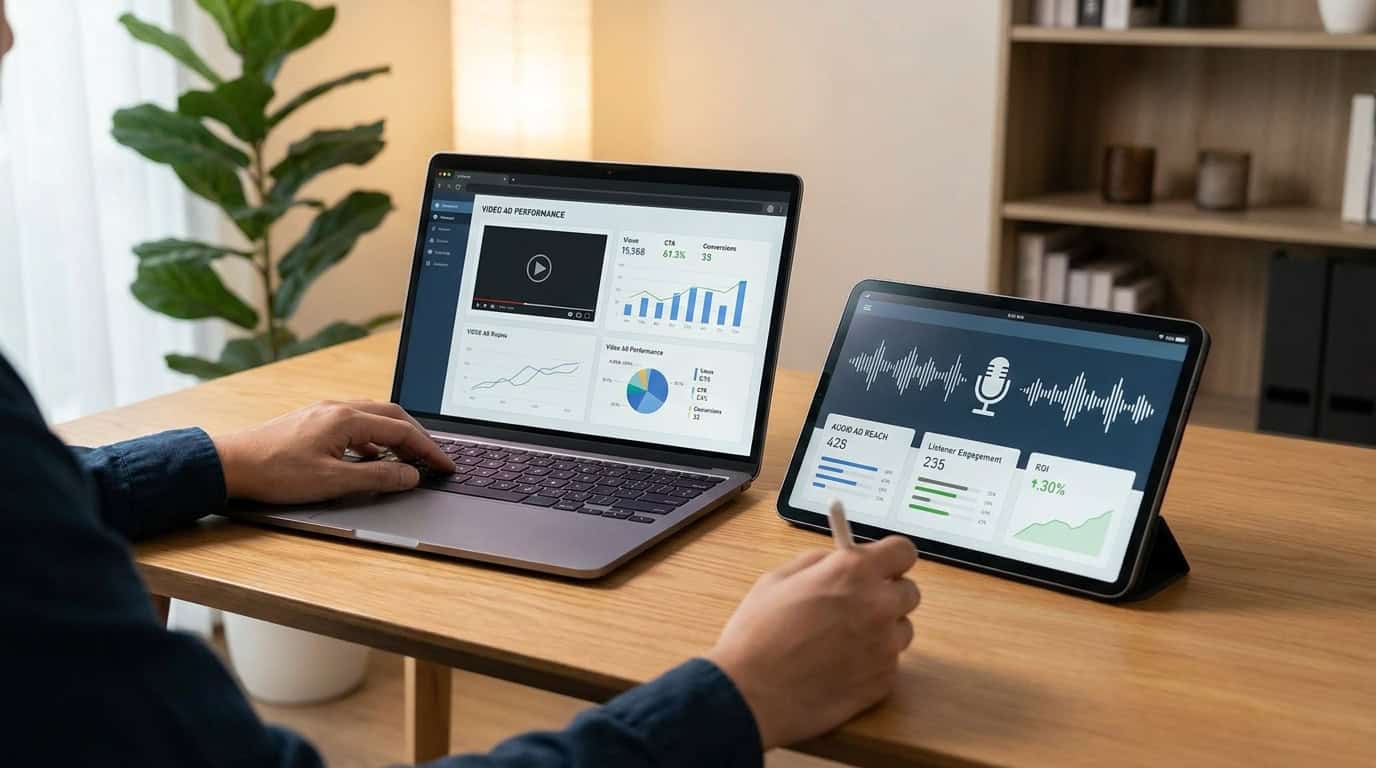
Performance Audio vs Video: Key Comparison Benchmarks
To help visualize the fundamental differences between these channels, consider the following performance benchmarks. These metrics represent the core trade-offs marketers face when allocating budget between visual and acoustic media. Each format offers unique strengths depending on your specific campaign goals.
| Metric | Digital Audio | Performance Video |
| CPM Range | $5 to $25 (Premium) | $10 to $65 (Premium) |
| Attention Efficiency | 10,126 attentive seconds per thousand | 6,501 attentive seconds per thousand |
| Conversion Reach | One in five listeners convert | Varies by screen environment |
Evaluating these metrics through the lens of your product's complexity is essential. These attention benchmarks, drawn from Dentsu's Attention Economy research in partnership with Lumen Research, demonstrate that while video offers high-impact visual proof, audio delivers unmatched cost efficiency per attentive second.
Performance Audio vs Performance Video: Key Media Mechanics and Direct Response Dynamics
Performance audio and performance video operate under fundamentally different sensory and psychological mechanics. While one relies on visual immersion and high-definition demonstration, the other capitalizes on the intimacy of sound and the efficiency of the listener's imagination. Choosing the right format depends on whether your product requires visual proof or a personal endorsement to drive action.
Direct Response Dynamics in Visual Media (Connected TV and YouTube)
High-definition visual demonstration allows brands to show product features and establish brand identity within the first three seconds of exposure. Video ads lower purchase friction for complex products by providing a clear view of the solution in action. Sight, sound, and motion combine to create a compelling narrative that's difficult to ignore on a large screen.
Connected TV has evolved from a niche channel into a mainstream advertising platform with ad spending exceeding $30 billion. Nearly 70% of the U.S. population now uses CTV platforms, allowing for real-time analytics on viewership and engagement.
While viewers often engage with non-skippable inventory, marketers must still account for challenges like screen fatigue and second-screening. These viewing habits require creative that grabs attention instantly and maintains it throughout the spot.
A CTV research study by Kargo found that enhanced Connected TV formats can provide a 54% attention lift compared to traditional 15-second TV spots. Utilizing on-screen calls to action and interactive overlays helps maintain high completion rates while driving specific viewer behaviors. For example, Sierra Nevada used Kargo's AI-powered Narrative format to dynamically transform static brand assets into premium, interactive CTV-ready ads that sustained viewer interest far longer than standard commercials.
Visual media also benefits from its ability to integrate shoppable elements directly into the viewing experience. Traditional TV commercials with QR codes let viewers scan with smartphones to access websites or special offers. QR code functionality bridges the gap between the living room and a mobile device for a seamless user journey. These interactive tools are transforming the television screen from a passive awareness vehicle into a direct-response engine.
The Attention Economy of Acoustic Channels (Streaming Audio and Podcasts)
According to EMARKETER, U.S. consumers spend an average of 2 hours and 42 minutes each day listening to audio, yet advertisers disproportionately underinvest in the channel. In 2025, U.S. digital audio ad spend reached a record $8.4 billion according to the IAB Internet Advertising Revenue Report, meaning digital audio represents only 2.8% of total U.S. digital media spend despite its massive daily footprint.
Dentsu's cross-platform attention research indicates that audio ads generate correct brand recall in 41% of follow-up surveys, outperforming the 38% norm seen across visual formats. This study, conducted with Lumen Research, also documented that audio ads average 10,126 attentive seconds per thousand impressions, which is more than 50% higher than Dentsu's historical benchmarks for video and display ads.
Acoustic media fosters a parasocial relationship between host and listener that increases brand preference. This intimate nature reduces ad resistance compared to disruptive pop-up video ads that interrupt the visual experience. Listeners often view their favorite podcast hosts or radio personalities as trusted figures, which enhances the receptivity of the message. This trust translates into a higher willingness to try new products recommended within the audio stream.
Because listeners are often multitasking, audio creative must be repetitive and clear. Successful ads often feature a simple, memorable URL and a strong verbal call to action, ensuring the listener can easily recall the message even while driving, working out, or cooking.
Efficiency and Cost Metrics: CPM Variations, Production Budgets, and Scale
Direct response marketers must evaluate the total cost of ownership, which includes asset creation, effective cost per thousand impressions, and the recurring maintenance required to keep creative fresh.
Upfront Investment and Asset Production Costs
Visual performance campaigns often require substantial upfront investments in video crews, studio rentals, and professional talent. Post-production editing and the creation of visual variants for testing further increase the total budget. These costs can quickly become a barrier for brands with tighter margins or those testing new product concepts. A single high-end video asset can cost tens of thousands of dollars before a single impression is even purchased.
Audio production costs remain a fraction of video budgets because they leverage voice talent and sound design. Some platforms even allow brands to transform static assets into audio ads using simple scripts and generative tools. Spotify Ads Manager simplifies this process by allowing marketers to create ads with only a script. A lower barrier to entry allows smaller brands to compete effectively alongside larger corporations without needing massive production crews.
Specifically, Sierra Nevada saved an estimated $500,000 on upfront production costs by using Kargo's AI-powered formats to construct Connected TV ads directly from existing image libraries and scripts. This programmatic conversion allows brands to bypass traditional studio and talent fees, creating an agile workflow to pivot messaging quickly based on real-time performance data.
Lower production costs in audio allow for aggressive A/B testing and faster iteration. Marketers can produce dozens of audio variations for the price of a single high-end video asset, allowing growth teams to isolate high-performing hooks, offers, and calls to action on tight creative budgets.
Evaluating CPMs, eCPMs, and Ad Completion Rates
Media buying cost structures vary significantly between programmatic Connected TV and digital audio. Typical CPMs for radio range from $5 to $6, while streaming video can reach as high as $65. Marketers must weigh these costs against the potential for engagement and the value of a completed view. High-priced video inventory is often justified by its 90%+ completion rate on the big screen.
Marketers should evaluate the "attentive CPM" to find true value. While high completion rates justify a higher sticker CPM on Connected TV, digital audio delivers unmatched cost efficiency per attentive second. This makes acoustic formats a highly efficient frequency builder that reinforces high-impact visual campaigns at a lower blended cost.
Programmatic CTV and premium video placements offer high-impact visual reinforcement but come with a premium price tag. Digital audio and dynamically inserted podcast ads often provide a more efficient path to reach the same audience. Balancing these costs requires a deep understanding of how each format contributes to the overall marketing goals. A hybrid approach often leads to the lowest blended cost per acquisition across the entire campaign.
Effective CPMs also depend on the targeting precision available within each platform. CTV allows for household-level targeting using first-party data, which justifies its higher entry price. Digital audio offers similar programmatic capabilities, often at a lower entry point for smaller budgets. By evaluating eCPMs based on conversion data rather than just impressions, brands can identify the most profitable channel for their specific product.
Managing Creative Fatigue and Asset Refresh Cycles
Video ads on platforms like YouTube suffer from rapid ad burn due to high visual saturation. This requires continuous creative variations to prevent rising costs per acquisition and declining engagement. Brands must maintain a constant pipeline of new visual assets to keep their campaigns effective. Without regular refreshes, even the most successful video ads will see a steady decline in ROI over time.
Acoustic messaging can often sustain performance longer because it exists in screen-free environments with lower frequency saturation. Most podcast campaigns maintain performance over a frequency range of six to nine exposures, allowing a single audio asset to remain effective far longer than a typical video ad.
Managing asset rotation effectively requires an agile production workflow for both channels. Audio ads allow for quicker pivots when performance dips, whereas video adjustments often involve longer lead times and higher expenses.
To maximize life cycles, some brands use audio-first narratives that can be easily updated with new offers. This strategy involves recording several different endings for a single core audio script. It provides a way to refresh the campaign's urgency without needing to re-record the entire creative. These small adjustments can extend a winning campaign's lifespan by several months.
Conversion Dynamics and Return on Ad Spend Across Formats
Understanding conversion dynamics requires looking beyond immediate click-through rates. Marketers must evaluate direct response mechanisms, endorsement authority, and the long-term impact on the entire sales funnel. Each format offers unique pathways for a consumer to take a direct action. Analyzing these dynamics reveals how different sensory experiences drive different types of consumer behavior.
Response Rates and Direct Action Signals
Users execute conversion actions differently across visual and audio environments. While YouTube offers clickable links directly on the screen, Connected TV and audio environments require strategic verbal repetition and memorable offers to offset the absence of direct touch targets.
Effective call-to-action strategies for non-clickable media include memorable vanity URLs and concise promo codes, alongside shoppable overlays or QR codes that connect the television viewer directly to their smartphone.
Benchmark data from Spotify Ad Analytics shows that one in five podcast listeners who engage with an advertiser end up converting. Globally, the platform's benchmark conversion rate for digital audio campaigns sits at 1.09%, demonstrating a highly competitive baseline compared to standard digital display formats.
Conversion speed also varies by channel, with video often driving faster results. However, audio's ability to stay top-of-mind means it often captures conversions that other channels miss. A combined strategy that uses video to introduce the product and audio to reinforce the offer typically sees the highest total conversion volume. This collaboration is the key to getting the most from your ad spend across a performance media budget.
Host-Read Trust Transfer vs Dynamic Ad Insertion
Host-read podcast ads act as personal recommendations from trusted personalities. This psychological phenomenon of trust transfer drives higher purchase intent and brand equity compared to standard voiceovers. Listeners are more likely to buy a product when it's endorsed by someone they follow regularly. It's an environment where the advertisement feels like a helpful tip rather than an interruption.
Data from Spotify Ad Analytics confirms that host-read podcast ads drive significantly higher conversion rates than programmatic pre-records due to the host's direct relationship with their audience. Conversely, dynamic ad insertion offers superior scale and programmatic targeting. According to Standard Media Index data, digital audio formats have steadily captured the majority of national audio advertising budgets, allowing brands to transition from niche sponsorships to automated, multi-show campaigns.
Performance marketers can balance these two approaches by using host reads for high-impact endorsements. Dynamic insertion can then provide the necessary scale to reach a wider audience across multiple shows. This hybrid strategy allows brands to capture the authenticity of host reads while benefiting from the precision of programmatic buying. It's a way to maintain the human touch of podcasting while achieving the reach of traditional radio.
Trust transfer isn't limited to podcasts; it can also occur in specialized streaming music environments. When a brand's message aligns perfectly with the listener's chosen mood or genre, receptivity increases. This contextual relevance is a powerful tool for driving conversions in audio. It ensures that the brand's voice is heard at exactly the right moment in the listener's journey.
Navigating the Technical Challenges of Cross-Device Attribution
Accurately tracking direct response video vs audio requires a combination of deterministic pixels and post-purchase surveys. Without a clear measurement framework, brands risk misallocating their budgets based on incomplete or siloed data. Modern performance marketers must move beyond last-click attribution to accurately measure how each channel influences the final purchase. This technical foundation is what allows a brand to scale its media spend with confidence.
Pixel-Based Tracking, Device Matching, and Vanity URLs
Pixel-based attribution and IP-device matching connect ad views on Connected TV or podcast listens to subsequent web visits. This technical mechanism allows marketers to see how an impression on one device leads to a conversion on another. These tools provide a deterministic look at the customer journey that was once impossible in traditional media. Understanding these connections is the only way to prove the true value of your audio vs video performance ads.
There are challenges with IP addresses as they reset frequently for many households. According to a Coalition for Innovative Media Measurement "Brave New World" report, approximately 27% of residential IP addresses reset every week, complicating long-term cross-device tracking. Additionally, some bid requests omit key metadata fields like app name or device type, making real-time attribution difficult and requiring advanced probabilistic modeling to fill the gaps.
Combining deterministic pixel data with probabilistic survey signals creates a more comprehensive attribution picture. Post-purchase checkout surveys remain a reliable way to verify where customers first heard about a brand. Vanity URLs and dedicated promo codes also provide a direct signal that's unaffected by browser tracking limitations. By triangulating these different data sources, you can build a highly accurate model of your campaign's performance.
Tracking pixels aren't just for video; they have become a standard tool in the audio world as well. Since launching its audio attribution tracking pixel, ad tech platform AdsWizz reports that over 1,300 campaigns have utilized this technology to track cross-device conversions. Their findings indicate that audio campaign conversion rates are on par with standard digital display formats, providing the hard evidence needed to justify larger investments in acoustic channels.
Media Efficiency Ratio and Marketing Mix Modeling
Media Efficiency Ratio calculates total revenue against total media spend to provide a macro view of campaign health. This metric captures the halo effects that individual platform reports often miss. It's an excellent tool for understanding the overall impact of a diversified media mix. While MER doesn't provide granular show-level data, it's a vital indicator of whether your total marketing investment is driving growth.
Advanced statistical modeling like Marketing Mix Modeling helps brands isolate the incrementality of streaming audio and Connected TV. These models prevent marketers from being misled by platform-reported numbers that might overstate credit for a sale. MMM is particularly useful for long-term planning and understanding market-level dynamics. It provides a strategic view that complements the tactical data from pixel-based tracking.
Different measurement approaches serve different purposes for a growing brand. MMM is best for high-level budget allocation, while multi-touch attribution is better for tactical optimization. Using incrementality testing for validation ensures that the reported returns reflect actual revenue growth.
For brands with seven-figure budgets, MMM is essential for identifying the point of diminishing returns in each channel. It helps you decide when to shift your next dollar from CTV into a podcast sponsorship. By analyzing historical data, MMM can predict how a change in the media mix will affect your bottom line.
Measuring Brand Lift Across Channels
Beyond immediate conversions, understanding how audio and video campaigns influence overall brand perception is critical. Brand lift studies measure shifts in awareness, ad recall, and purchase intent by surveying exposed audiences versus a control group. By running these studies concurrently across podcast and CTV campaigns, marketers can identify which medium is most effective at driving top-of-funnel consideration.
Resolving Cross-Channel Cannibalization in Hybrid Campaigns
Running simultaneous audio and video campaigns creates a risk of double-counting conversions where both platforms claim credit for the same customer journey. Without a unified multi-touch attribution framework or matched-market holdout testing, brands risk over-investing in duplicate conversions rather than true incremental sales.
Implementing unified multi-touch attribution frameworks helps to eliminate reporting duplication. Marketers should also conduct geo-targeted holdout tests, which involve temporarily pausing ads in specific regions to isolate the direct impact on sales and calibrate probabilistic attribution models.
Geographic split testing provides a clear way to see how specific channels drive revenue in isolated markets. This data ensures that every dollar spent is contributing uniquely to the bottom line. Resolving these measurement challenges is essential for scaling a multi-channel performance strategy effectively. It's the only way to ensure your media budget is working at maximum efficiency.
By comparing the results of these tests, you can identify which channels are the best "lead" formats for your specific audience. Some brands find that audio acts as a low-cost frequency builder that makes their high-impact CTV ads more effective. Others discover that video is necessary to "seal the deal" after a long period of audio exposure. These insights are only possible when you move beyond siloed platform reporting.
Choosing the Right Mix: Strategic Decision Framework for Performance Marketers
Allocating budgets effectively requires a decision framework based on product complexity, target cost per acquisition, and campaign goals. Calculating podcast ad ROI and comparing it directly to CTV benchmarks helps define this strategic direction.
When Should You Lead with Performance Video Advertising?
Performance video is the primary choice for visually complex software products or high-aesthetic direct-to-consumer goods. These products require step-by-step visual demonstration to build trust with the audience. Video allows the brand to showcase the tangible benefits of a solution in a way that sound alone cannot achieve. It's an ideal format for products that have a high "wow" factor when seen in action.
Brands with established video production pipelines and higher gross margins can more easily absorb the higher costs. These companies use Connected TV and YouTube to achieve rapid scale across broad demographics. Video is also preferable when the marketing goal is to establish a brand identity rapidly in a competitive market. A high-impact video campaign can create a sense of scale and authority that is difficult to match in other channels.
Connected TV can offer real-time analytics on viewership and conversion metrics that are highly valued by data-driven teams. When the product is inherently visual, the combination of sight and motion drives immediate action, securing household attention in a leaned-back viewing environment.
However, video leaders must be prepared for the high cost of creative refreshes. Because visual saturation happens quickly, you'll need to produce new assets every few months to maintain your ROAS. If your team doesn't have the capacity for constant video production, starting with audio is a more sustainable choice.
When Should You Lead with Performance Audio Advertising?
Audio advertising is an effective lead channel when brands face high video CPM inflation or tight production budgets. According to data from Guideline, podcasts have become the category's primary growth engine, representing 77% of all digital audio ad revenue growth in 2025 and projected to capture 35% of total digital audio ad spend in 2026.
Service-based businesses and subscription models can leverage the high recall and intimacy of podcasting. This format is ideal for targeting niche audiences that are difficult to reach on visual social feeds. Brands that depend on trust and personal recommendation find that audio provides a natural environment for their message. The choice between audio vs video performance ads often comes down to the level of personal trust required to make a sale.
Audio is also a strategic choice for brands targeting consumers during screen-free times of the day. Because audio production is more cost-effective, it allows for a higher volume of creative testing. This makes it easier to find a winning message without risking a massive production budget. You can often launch an entire audio campaign for less than the cost of a single professional video shoot.
A Nielsen study on podcast ad effectiveness shows that these placements can boost brand awareness by 13 percentage points. Yet, since only 49% of marketers feel confident in their ability to measure this return, sophisticated advertisers who implement multi-touch modeling can secure highly undervalued, high-recall inventory.
Unlocking Synergies Through Integrated Audio-Video Performance Media
Combining performance audio and Connected TV creates a multi-touch ecosystem that outperforms isolated strategies. Integrated campaigns can drive 27% higher purchase intent than audio-only efforts, while studies from major audio platforms show that a combined approach can lead to 66% more incremental sales.
Audio ads maintain frequency during screen-free daytime hours while video secures high-impact reinforcement in the evening, building brand familiarity and trust across a diversified daily media diet.
Specific guidance for integrated campaigns includes using consistent offers and cross-channel retargeting. When a listener hears an ad during their morning commute and sees a similar ad on their TV that evening, the impact is compounded. This creative synchronization lowers the total cost of conversion by building on previous exposures. It's a highly efficient way to move prospects through the funnel from initial awareness to final purchase.
Research indicates that adding podcasts to a mix of TV and online video can increase short-term returns on ad spend by up to 18%, with audio building low-cost frequency and video driving the final conversion.
Optimize Your Performance Ad Returns with Mynt Agency
Optimal returns on ad spend require strategic alignment of channel selection with campaign maturity and audience behavior. While Connected TV and YouTube offer high-impact visual proof and rapid scale, digital audio provides unmatched attention efficiency and brand recall in screen-free moments. Understanding the financial and operational trade-offs between these formats is essential for building a sustainable growth engine.
Winning in the performance marketing landscape requires moving beyond siloed channels and establishing sophisticated cross-platform attribution and creative testing. By integrating these channels, brands capture attention across the entire consumer journey while minimizing wasted media spend.
Mynt Agency's expertise allows us to create high-impact video and audio campaigns that drive measurable results. We blend creative strategy with data-driven media buying and advanced analytics across Connected TV, YouTube, streaming audio, and podcasts. Contact us today to maximize your returns and accelerate your growth through expert orchestration of your performance media.
