
- By utilizing a shared network gateway, IP-based ad attribution effectively links non-clickable streaming TV impressions to specific web-based actions and purchases.
- Household identity graphs organize complex digital signals by mapping residential IP addresses to connected devices, enabling highly accurate cross-device measurement at scale.
- Advertisers can bridge the attribution gap by using tracking pixels and Conversions APIs to connect post-view website traffic back to the original connected TV exposure.
- Data Clean Rooms provide a privacy-compliant framework for marketers to match first-party conversion data against publisher impression logs without exposing raw personal identifiers.
- Conducting incrementality testing and defining optimal view-through windows allows performance marketers to prove causal conversion lift and maximize cross-device return on ad spend.
Digital video will generate $63 billion in ad spend in 2024. Roughly 89.5% of US households now own at least one internet-connected TV device. Performance marketers often struggle to bridge the gap between these large-screen impressions and web-based actions.
The solution lies in IP address matching, streaming TV impressions to specific household behaviors. By utilizing a shared network gateway, brands can link a non-clickable smart TV exposure to a smartphone purchase.
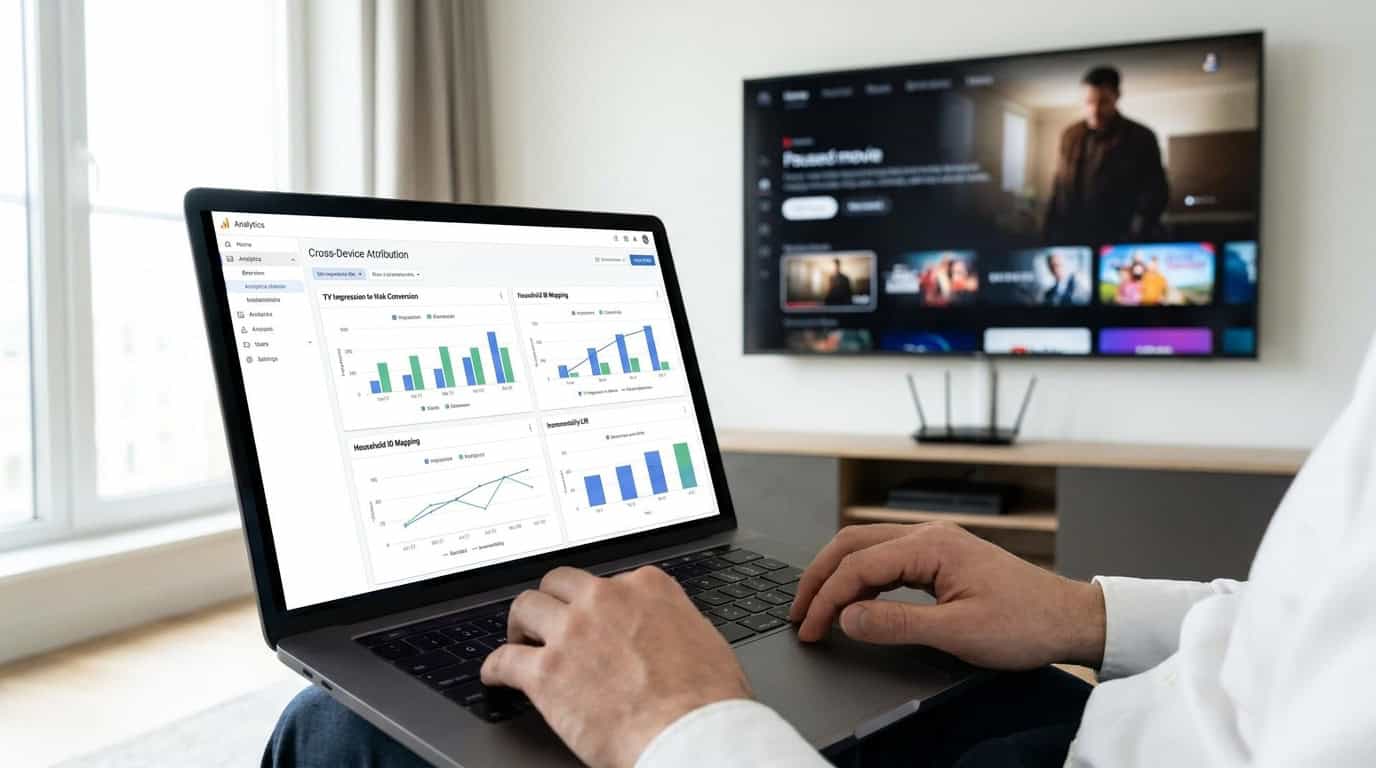
Technical Mechanics of IP-Based Ad Attribution in Streaming TV
What is IP-based ad attribution? IP-based ad attribution is a measurement method that tracks ad exposures on a smart TV and connects them to website actions on other devices within the same household by matching their shared public internet protocol address.
IP-based ad attribution provides the foundational infrastructure required to measure performance in modern over-the-top and connected TV environments. These methodologies allow advertisers to move beyond simple reach metrics and begin tracking actual consumer journeys through the digital sales funnel.
The Core Challenge: Non-Clickable Screens and Attribution Gaps
A television screen is inherently non-clickable, meaning traditional click-through rates cannot serve as a viable performance metric. Consumers watch high-quality video content on a device that lacks a mouse or touch interface. Lacking a traditional interface historically forced performance marketers to view television purely as a medium for brand awareness.
Resolving this gap requires attribution engines utilizing 98% accurate IP-to-physical address mapping. Because no cookie persists on a Roku or similar streaming stick, the industry had to develop alternative identifiers. Pivoting from direct clicks to cross-device observation allows streaming TV to function as a performance-driven channel.
The Function of IP Addresses as the Connective Identifier
The household IP address identifies the shared network gateway for all connected devices. Smart TVs, gaming consoles, smartphones, and tablets all share the same public household IP address provided by the internet service provider. A shared network signature allows ad servers to create a deterministic anchor point for every impression delivered to a large screen. Matching an IP address to a location can yield contact at a 95% or greater confidence level for one-to-one marketing. This level of precision allows the physical street address of a household to be mapped to digital identifiers used during ad delivery. By capturing this data at the moment of exposure, platforms create a searchable history for comparison against web traffic.
When a supply-side platform delivers a video ad, it logs the device's public IP address alongside specific exposure timestamps. This log serves as the baseline record for the household's interaction with the brand. Because the IP address is linked to a physical modem, it provides a high-confidence connection to a specific residential location.
How Household Identity Graphs Map Connected Devices
Advanced ad tech platforms don't rely on raw IP addresses alone; instead, they use them to build structured household graph targeting systems. These graphs organize the complex web of digital signals into a coherent view of the modern home. Identifying these relationships is what makes multi-device measurement possible at scale.
Residential IP Resolution vs. Dynamic IP Address Fluctuations
Residential IP addresses differ significantly from the static addresses found in corporate offices or data centers. Most home internet connections use dynamic host configuration protocols, which means the IP address assigned to a household can change periodically. Identity vendors must continuously validate these addresses to ensure that an impression delivered yesterday still maps to the same household today.
Many residential IP addresses remain stable for an average of nine months. Residential connection stability is much higher than that of mobile devices, which frequently bounce between different network addresses throughout the day. Sophisticated platforms filter out public Wi-Fi hotspots and VPN signals to maintain the integrity of their residential mapping.
By isolating verified residential gateways, marketers avoid the noise created by commercial networks or server farms. Filtering these networks ensures attribution is only applied when there is high confidence in the household's identity.
Deterministic vs. Probabilistic Matching Methodologies
Deterministic matching represents the highest level of accuracy because it relies on exact identifiers like hashed email addresses. When a user logs into a streaming app on their TV and later logs into a retailer's website using the same credentials, a direct link is established. This method typically yields match rates between 60% and 80% when sufficient authentication data is available.
- Deterministic Matching: Relies on exact, authenticated identifiers such as hashed emails or user logins (60% to 80% match rate).
- Probabilistic Matching: Uses statistical modeling and network signals like IP addresses and device characteristics to infer connections (85% to 95% coverage).
Step-by-Step Process: From Connected TV Impression to Web Conversion
Tracking a TV impression to a digital purchase requires multiple technical handshakes. Every server ping matters. If a single step drops, the attribution model breaks. This workflow allows brands to treat television as a measurable performance engine.
Step 1: Smart TV IP Tracking and Impression Metadata Capture
The process begins the moment a video ad is served to a streaming device or smart TV. Smart TV IP tracking systems record the raw metadata of the event, including the exact timestamp and the campaign ID. This log also includes the creative ID and the streaming app's user agent, which helps identify the specific context of the ad delivery.
Capturing the baseline exposure is vital because it establishes the start of the attribution window. Ad platforms collect this information via a network server ping or a momentary redirect during the ad call. Without this baseline record of the exposure, it's impossible to reconcile later web activity with the television campaign.
Every engagement recorded at this stage is eligible for future attribution based on the rules defined by the advertiser. The data is stored in a secure environment where it can be queried once conversion events begin to flow in.
Step 2: Mapping Exposure Data to the Household Identity Graph
Identity resolution maps digital buyer signals to specific household smart TVs. Once the metadata is captured, the ad server passes the log to a household identity engine. The household identity engine resolves the raw IP address against a massive database of known device relationships, mapping out a unified device graph that connects Wi-Fi tokens, mobile IDs, and browser histories.
Household mapping is the cornerstone of graph targeting, ensuring every device in the home is accounted for. The engine identifies all secondary device identifiers, such as mobile advertising IDs and desktop browser tokens, associated with that specific home network. The identity graph acts as a translator, turning a single IP address into a list of potential devices where a conversion might occur.
Data structuring is what makes cross-device measurement possible at scale. It ensures that the brand does not lose sight of the consumer as they move between different screens. The graph is updated in real time to reflect new devices entering or leaving the household environment.
Step 3: Detecting Cross-Device Web Activity and Attribution Pixels
The next stage occurs when a consumer in the exposed household visits the advertiser's website or app. This activity is tracked using a 1x1 pixel tracking script or server-to-server Conversions API installed on the brand's digital properties. While invisible to the visitor, the tool records the visit alongside the current IP address and user-agent string.
When the pixel fires, it captures details such as page views, add-to-cart actions, and completed purchases. These events are sent back to the attribution platform in real time for processing. The pixel creates the digital bridge necessary to link the web traffic back to the earlier television exposure.
Advertisers use these pixels to monitor the entire post-view journey rather than just the final sale. For example, Strategus industry benchmarks show a campaign might drive 80,601 website visits but only a few hundred direct purchases. Tracking every step of the process provides a more complete picture of how the streaming ad is influencing consumer behavior.
Step 4: Resolving View-Through Conversions and Multi-Touch Attribution
The final step involves comparing the timestamp and IP address of the website conversion against the historical log of CTV exposures. If a match is found within a pre-defined lookback window, the event is classified as a view-through conversion. This proves that the household saw the ad before visiting the site and completing the desired action.
Attribution platforms use specific rules to determine which campaign gets credit when multiple touchpoints exist. Multi-touch models weigh the CTV impression alongside search and social ads to evaluate the true impact of each channel.
Overcoming Signal Loss: Privacy Regulations and IP Obfuscation
New privacy protocols actively disrupt IP-based tracking. Marketers must navigate new privacy features and regulations that aim to protect consumer identity while maintaining measurement accuracy. Advanced filtering and identity resolution are necessary to ensure that ad spend is not wasted on inaccurate traffic.
Navigating Apple Private Relay, VPNs, and Dynamic IP Masking
Features like Apple's Private Relay and consumer VPNs are designed to obscure a user's true IP address. These systems route traffic through proxy servers, which can make a single household appear as if it's coming from a different location. These proxy servers create signal noise that can lead to false matches or missed attributions.
Mobile networks also use carrier-grade Network Address Translation, which results in many different users sharing a single public IP address. In these environments, relying solely on IP tracking can be unreliable and may be classified as fingerprinting. Sophisticated ad networks must identify these masked signals and isolate them to prevent skewed data.
The Transition from IPv4 to IPv6 Tracking
As the industry exhausts traditional IPv4 addresses, the transition to IPv6 provides a massive expansion in available routing identifiers. Because IPv6 enables direct device-level assignments without relying as heavily on Network Address Translation, it inherently improves attribution accuracy by reducing the volume of shared public IPs.
To combat this, leading platforms use secondary signals to verify the household's identity. They may prioritize deterministic logins or use advanced filtering to exclude known proxy addresses. Identifying these obfuscated signals is necessary to ensure that ad spend is not wasted on unmeasurable traffic.
Technical Privacy Frameworks, Data Clean Rooms, and Consent Standards
Regulatory frameworks like the California Consumer Privacy Act and the General Data Protection Regulation explicitly include IP addresses in their definitions of personal information. Tracking must be handled with extreme care and often requires explicit user consent according to IAB measurement standards. Advertisers must ensure their data collection practices comply with these state and international laws.
Many brands now use Data Clean Rooms to match their first-party CRM data against publisher impression logs in a privacy-safe way. These environments allow two parties to join their datasets without ever exposing raw device identifiers or personal records to each other. Matching data in clean rooms preserves consumer privacy while still allowing for high-accuracy attribution.
Privacy-preserving approaches using differential privacy can often maintain 60% to 80% of traditional identity resolution capabilities. By utilizing anonymized identity tokens, marketers can continue to measure performance without violating regulatory standards. This balance between privacy and performance is the new standard for the streaming advertising industry.
Key Attribution Metrics and Decision-Making for Growth Marketers
Data only holds value when growth teams know how to apply it. Strategic decisions around attribution windows and incrementality are what ultimately drive campaign success. Implementing performance-driven CTV attribution ensures that every dollar spent is tied to a measurable result.
Selecting the right lookback window is a delicate balance based on the length of the sales cycle and product price. For impulse e-commerce purchases or promotional offers, a 7-day window is often most effective at capturing immediate intent. High-consideration products, such as those in the B2B space, may require 14 to 21 days to account for longer decision-making processes.
Studies from major platforms like Roku and Samsung suggest that approximately 80% of CTV-influenced conversions occur within 14 days of exposure. Setting a window that's too short may result in under-reporting the true impact of the campaign. Conversely, an overly generous window risks over-attributing organic traffic that would've occurred regardless of the ad.
Marketers should calibrate these windows by analyzing the typical time-to-conversion for their specific audience. This data-driven approach ensures that the attribution model reflects the actual behavior of the target consumer. Consistent calibration is the best way to maintain the integrity of performance reports.
Marketers must distinguish between correlated view-through conversions and true incremental lift. While IP matching proves that a conversion occurred after an ad was seen, it doesn't always prove the ad caused it. Incrementality testing is the only way to verify whether the streaming TV impression directly changed consumer behavior.
Marketers use randomized controlled trials or geo-matched market testing to measure this lift. By comparing a test group that saw the ads to a holdout group that didn't, brands can calculate the number of conversions that wouldn't have happened otherwise. Well-executed tests often show a 15% to 35% lift in conversion probability among exposed households.
Utilizing an always-on incrementality approach creates a causal connection between the start of a campaign and an improvement in overall performance. This higher level of analysis helps growth leaders justify their budgets to executive stakeholders.
Maximizing Cross-Device ROAS with Performance-Driven CTV Strategies
Media buyers can significantly improve their results by applying specific execution tactics to their streaming campaigns. Growth teams must focus on data hygiene and omnichannel coordination to drive the highest possible return on investment.
Eliminating Wasted Ad Spend Through Qualified IP Filtering
One of the most effective ways to improve performance is through strict pre-bid verification and cross-device IP resolution. Truthset research suggests that $7.4 billion of programmatic spend is wasted due to inaccurate data signals. Ensuring that ad dollars are spent exclusively on verified residential streaming environments dramatically improves match rates.
Effective filtering excludes commercial networks and public Wi-Fi hotspots before the bid is even placed. This proactive approach helps brands avoid the common pitfall where only 23% of residential IPs reach their intended geographic target. By focusing on high-confidence residential gateways, marketers can ensure their attribution data remains clean.
When campaigns are optimized for quality visits, they often see a significantly lower cost per conversion. Some brands have reported a 79% lower cost per quality visit when using these optimized algorithms for better engagement.
Coordinating Omnichannel Messaging Across TV, Mobile, and Desktop
Household identity graphs allow growth marketers to execute sophisticated sequential storytelling across multiple screens. A user who views a high-impact video on their smart TV can be automatically retargeted with follow-up ads on their mobile device or laptop. This reinforcement keeps the brand top-of-mind and provides an easier path for the consumer to click and convert.
Exposure to streaming ads leads to a 9% increase in brand searches and an 11% increase in clicks per user. By coordinating messages across the Microsoft Audience Network, brands can capitalize on this increased intent. This omnichannel approach ensures that the awareness generated on the big screen is harvested on smaller, clickable screens.
Retargeting works by matching first-party CRM data or pixel-based site visits to household devices using privacy-compliant graphs. This allows for a seamless transition from a passive viewing experience to an active digital engagement.
IP address matching and household identity graphs have transformed streaming TV into a powerful performance vehicle. By bridging the gap between non-clickable television screens and digital web activity, these technologies allow growth marketers to track the full consumer journey with high precision. As digital video spend continues to outpace linear television, the ability to resolve cross-device identities will remain the defining factor for successful advertising campaigns.
Mynt Agency turns complex technical work into measurable business growth for your brand. We blend high-impact creative video and audio strategy with data-driven media buying and advanced IP-based ad attribution to maximize your ROAS. Whether you're scaling on CTV, YouTube, or streaming audio platforms, our performance-driven approach ensures every impression is tied to a real-world action.
Contact us today for a custom CTV attribution audit and learn how to tie every streaming impression to your bottom line. Our team will help you make the most of your omnichannel marketing stack and grow sustainably with scientific attribution.
